

Unlocking Acquisition Financing in Mexico: Why Security Trusts Matter for Sponsors



Unlocking Acquisition Financing in Mexico: Why Security Trusts Matter for Sponsors
For private equity sponsors acquiring businesses in Mexico, the critical question is often less “can I win this asset?” and more “can I finance it on terms that make sense?” In a market where lenders’ comfort with local collateral determines leverage, pricing, and funding certainty, Mexico’s security trust (fideicomiso de garantía) has become a central building block of sponsor-backed dealmaking. While it is formally a lender-protection device, sponsors who understand and embrace the structure can unlock deeper lender appetite, higher debt capacity, and cleaner execution in competitive processes.
What a Security Trust Actually Is
A Mexican security trust is a triangular arrangement between a settlor (typically the borrower or target), a trustee (a licensed Mexican bank), and beneficiaries (usually the lenders) under which assets are transferred into a trust for the benefit of creditors. Functionally, it combines the role of a collateral trustee with a bankruptcy-remote special purpose vehicle: the trustee takes legal title to the assets, which will be segregated from, and will not be comingled with, the borrowers’ assets in an insolvency proceeding, and accordingly, the assets are not subject to any Mexican wage lien claims or other insolvency-related claims. As a result, third-party creditors of the relevant borrower will not be entitled to create a lien on any of the assets transferred to the security trust.
Although title to the collateral is transferred to the security trust, the borrower is given the flexibility to use the assets until the beneficiaries deliver a notice of an event of a default.
The real power of the structure lies in enforcement. Instead of relying on traditional mortgages or pledges that typically require lengthy court processes to foreclose, the trust allows parties to pre-agree on an extrajudicial enforcement path, enabling the trustee to sell or transfer collateral upon default. For sponsors, that means lenders can take comfort in recoveries without insisting on overly conservative leverage or punitive pricing; for lenders, it means a clearer, faster path to collateral realization in a default scenario.
Why Lenders Care – and Push for It
From a lender’s perspective, the security trust checks every major credit-protection box. First, bankruptcy remoteness: assets in the trust are legally separated from the borrower’s estate, so an insolvency filing does not automatically sweep those assets into court proceedings. Second, faster enforcement: the trustee follows a pre-negotiated playbook — notice, cure period, sale or transfer, then distribution of proceeds — rather than years of litigation and uncertain recoveries.
Third, a single trust can hold multiple asset classes — shares of the Mexican target, receivables, bank accounts, real property, and intellectual property — thereby creating a comprehensive collateral package in a single instrument. Fourth, in syndicated deals, the trust simplifies syndication dynamics by designating a single beneficiary (often a collateral agent) to act on behalf of all lenders, reducing the coordination risk that plagues multi-lender enforcement. Finally, the structure is well understood by Mexican courts, banks, and counsel, reducing execution risk and making it a default expectation in institutional financings.
Why Sponsors Quietly Win Too
Although the trust is framed as a lender tool, the economic benefit ultimately flows to sponsors. Stronger, more enforceable collateral gives lenders the confidence to advance more capital against the same asset base, supporting higher leverage multiples in competitive auctions. That same comfort often translates into tighter spreads and, in some cases, more flexible covenant packages, improving the sponsor’s all-in cost of capital.
The structure also broadens the lender universe. Foreign banks and global private credit funds that might hesitate to lend into Mexico on the back of standalone pledges are significantly more comfortable when collateral sits inside a well-documented security trust. In more complex capital stacks — combining senior, mezzanine, and seller instruments — the trust can host the full waterfall of security and payments under one umbrella, reducing intercreditor friction and creating room for seller notes, earn-outs, or other creative features that help sponsors close deals. Sponsors who move beyond viewing the trust as a “bank-imposed condition” and treat it as part of their financing strategy typically achieve better leverage and more competitive terms.
How It Works in a Sponsor-Backed Acquisition
A typical acquisition financing using a Mexican security trust might involve senior debt alongside a seller note. The shares of the Mexican target are transferred into the trust, so the trustee — rather than the borrower directly — holds legal title. Senior lenders are designated as first beneficiaries; if the borrower defaults, the trustee may sell or appropriate the shares for their benefit, in accordance with a pre-agreed enforcement process.
The seller providing subordinated paper can be named as a second beneficiary, receiving distributions only after the senior lenders are repaid under the agreed waterfall. Operating revenues are routed through trust accounts and applied in the following order: operating costs, senior debt service, seller note, and residual equity distributions. For lenders, this centralizes control over cash flows and collateral; for sellers, it provides assurance that their subordinated position is formally recognized and administered; for sponsors, it brings both parties into a single, coherent structure that supports a larger, more flexible financing package.
Costs, Frictions, and Nuances Sponsors Must Manage
Security trusts are powerful, but not free or frictionless. Sponsors must budget for trustee setup and annual fees, as well as notarial and registry costs, which can become significant for large real estate or high-value asset pools. Drafting, negotiating, and registering the trust can take weeks, so deal teams need to build the trust workstream into their closing timeline rather than treating it as a late-stage documentation item.
Trustee selection also matters. Not all banks are equally efficient in their trustee role, and poorly drafted service standards can lead to delays at critical moments, including enforcement, refinancing, or amendments. While recent Mexican court precedents generally support the bankruptcy-remote nature of security trusts, past inconsistent rulings make robust local legal opinions on enforceability and insolvency treatment essential. Finally, not every asset — such as certain concessions, permits, or contracts — can be freely transferred into a trust, which may require parallel security arrangements and careful coordination with third-party consents.
Trends and Practical Guidance for Deal Teams
Several trends are solidifying security trusts as standard infrastructure for sponsor-backed deals in Mexico. Global private credit funds are increasingly active in the market and almost universally require security trusts, reinforcing their status as a baseline expectation in institutional financings.
Trusts are also used to control disbursements in ESG and sustainability-linked loans, assuring lenders that proceeds are channeled to agreed-upon green or social projects. As specialized courts continue to clarify treatment of trusts in insolvency, confidence in their bankruptcy-remote profile is strengthening, further normalizing their use.
For private equity deal teams, the practical playbook is straightforward. Map collateral early and determine which assets will sit in the trust, and which require third-party approvals or parallel security. Engage a prospective trustee at the outset to negotiate economics, service levels, and replacement mechanics. Coordinate trust drafting with intercreditor arrangements so that beneficiary rankings and waterfalls are embedded in a single, coherent framework. Most importantly, treat security trust as a strategic tool to make your financing more bankable and competitive — in Mexico, sponsors who master the trust structure are often the ones best positioned to win and close the deals they care about most.
Configure Partners
Configure Partners is a credit-oriented investment bank specializing in debt placement. The firm provides the highest level of client service and execution to middle-market private equity sponsors in acquisition finance, refinancing, and dividend recapitalization transactions, with expanding expertise in cross-border transactions. Configure is one of the largest firms dedicated to debt advisory. We’ve developed our processes and systems to ensure execution across all types of financing transactions. Unlike other debt placement groups, we don’t treat debt advisory as a secondary service offering to M&A — debt placement is a core part of our business.
Importantly, we consider ourselves an extension of our clients in the market, and we treat lenders accordingly. The cumulative effect of this approach is particularly powerful in a more difficult financing environment where debt capital is less “abundant.” The results of the Configure methodology speak for themselves, with over 80% of our revenue coming from a repeat source of business.
If the above article has sparked a question or thoughts concerning unlocking acquisition financing in Mexico, please feel free to reach out to any of our Configure team members or visit our website at https://configurepartners.com/.
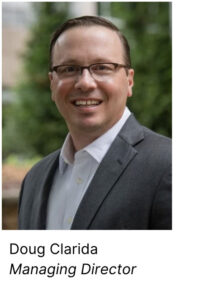 About Doug Clarida
Joining Configure in 2018, Doug brings over 30 years of direct lending and advisory experience at middle-market credit platforms.
Before Configure, he was a Director with ING Capital, responsible for sourcing cash flow and asset-based debt investments, underwriting transactions, and portfolio management. He also held similar positions at GE Capital, Heller Financial, and Banque Paribas.
Doug holds a bachelor’s degree in Finance from the University of Illinois at Urbana-Champaign and was a letterman on the 1991-1992 Illinois men’s basketball team. He is a FINRA General Securities Registered Representative (Series 7, 63).